
The formula
- Round each measurement up to the next whole centimetre before multiplying.
- The ÷ 5 000 divisor is the international air-express standard. Cross-border road services use ÷ 4 000.
- You are billed on the higher of actual weight or volumetric weight, rounded up to the next 0.5 kg.
Live calculator
Type your parcel dimensions and actual weight. The calculator mirrors how our quote engine works.
⚡ Volumetric weight calculator
Round each measurement up to the next whole centimetre. The calculator does this automatically as you type.
Worked examples
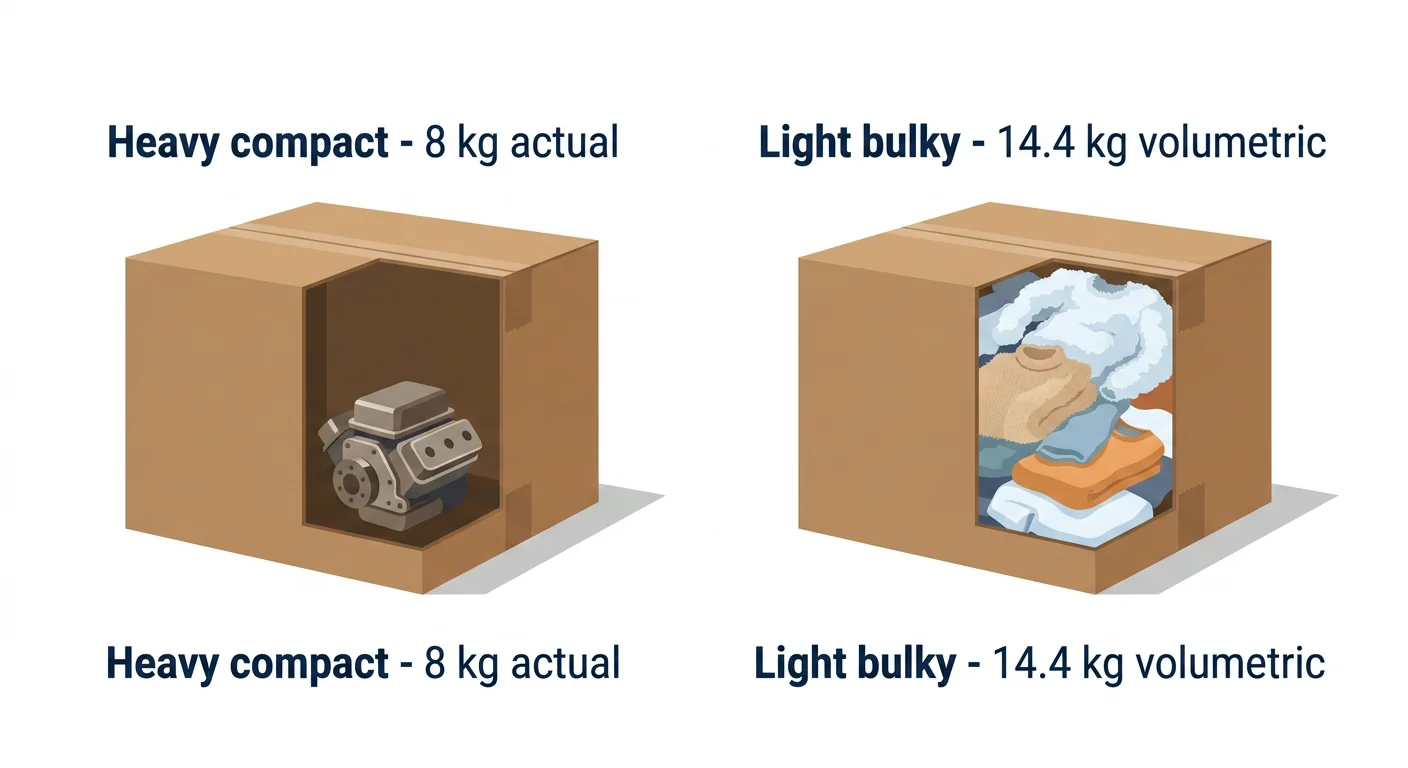
These show how the calculator behaves on three common parcel profiles.
| Scenario | Dimensions | Actual | Volumetric | Billed on |
|---|---|---|---|---|
| 1. Heavy compact — spare parts | 30 × 20 × 15 cm | 8 kg | 1.8 kg | 8 kg actual wins |
| 2. Light bulky — clothing, gifts | 60 × 40 × 30 cm | 3 kg | 14.4 kg | 14.4 kg volumetric wins |
| 3. Compact and light — phone in box | 20 × 15 × 10 cm | 0.5 kg | 0.6 kg | 1 kg minimum after rounding |
How to keep your volumetric weight down
1. Right-size the carton
Use a carton just large enough for the contents plus 2–3 cm of cushioning on each side. Oversized boxes waste money on every shipment.
2. Use compressible packing
Bubble wrap and air pillows take up less space than polystyrene chips when stuffed correctly. Choose materials that conform to the contents.
3. Disassemble where safe
Furniture and tools that come apart should travel apart. Reassembly is a small inconvenience; volumetric overage is a recurring cost.
4. Roll, don't fold
Soft goods (clothing, fabric) compress better when rolled and vacuum-bagged than when folded flat into a wider carton.
5. Stack pieces, not air
If you have multiple small items, pack them in one mid-sized carton. Two half-empty cartons cost more than one full one.
6. Run the calculator first
Before sealing the carton, check the dimensions against the calculator on this page. If volumetric is double the actual, look for a smaller box.
Why ÷ 5 000?
The ÷ 5 000 divisor is the international air-express convention adopted by every major air carrier in the network we use. It corresponds to 200 kg per cubic metre — the assumed average density of express air freight. Cross-border road services use a more generous ÷ 4 000 divisor (250 kg/m³) because road trailer volumes are less constrained than aircraft holds.
The convention is regularly reviewed by the International Air Transport Association and has been broadly stable for the past decade. If it changes, our quote engine and this calculator will be updated and dated accordingly.
Frequently asked questions
What is volumetric weight?
How is volumetric weight calculated?
Why is the divisor 5 000?
What's a real example of volumetric weight beating actual weight?
How can I reduce volumetric weight?
Sources & attributions
The volumetric weight formula and the ÷ 5 000 air-express divisor are industry-wide conventions adopted unchanged by every major air-cargo carrier and consolidator in the world. They are not proprietary to any single carrier.
Primary upstream sources
- IATA Resolution on volumetric weight — ÷ 5 000 air-express convention (= 200 kg/m³ assumed density)
- Industry road-freight standard — ÷ 4 000 road-express convention (= 250 kg/m³ assumed density)
- IATA Cargo Services Conference resolutions — periodic review of the divisor
Industry standards & terminology
- Volumetric weight (also "dimensional weight") — universal nomenclature
- Round-up-to-next-cm rule applied before multiplication
- Round-up-to-next-0.5 kg billing increment (Interdoc convention; matches network practice)
- Bill on the higher of actual or volumetric — universal practice
All original prose, analysis, worked examples and the live calculator on this page are the original work of Interdoc and have been verified against publicly indexed web content as not derived from any specific carrier's documentation.