
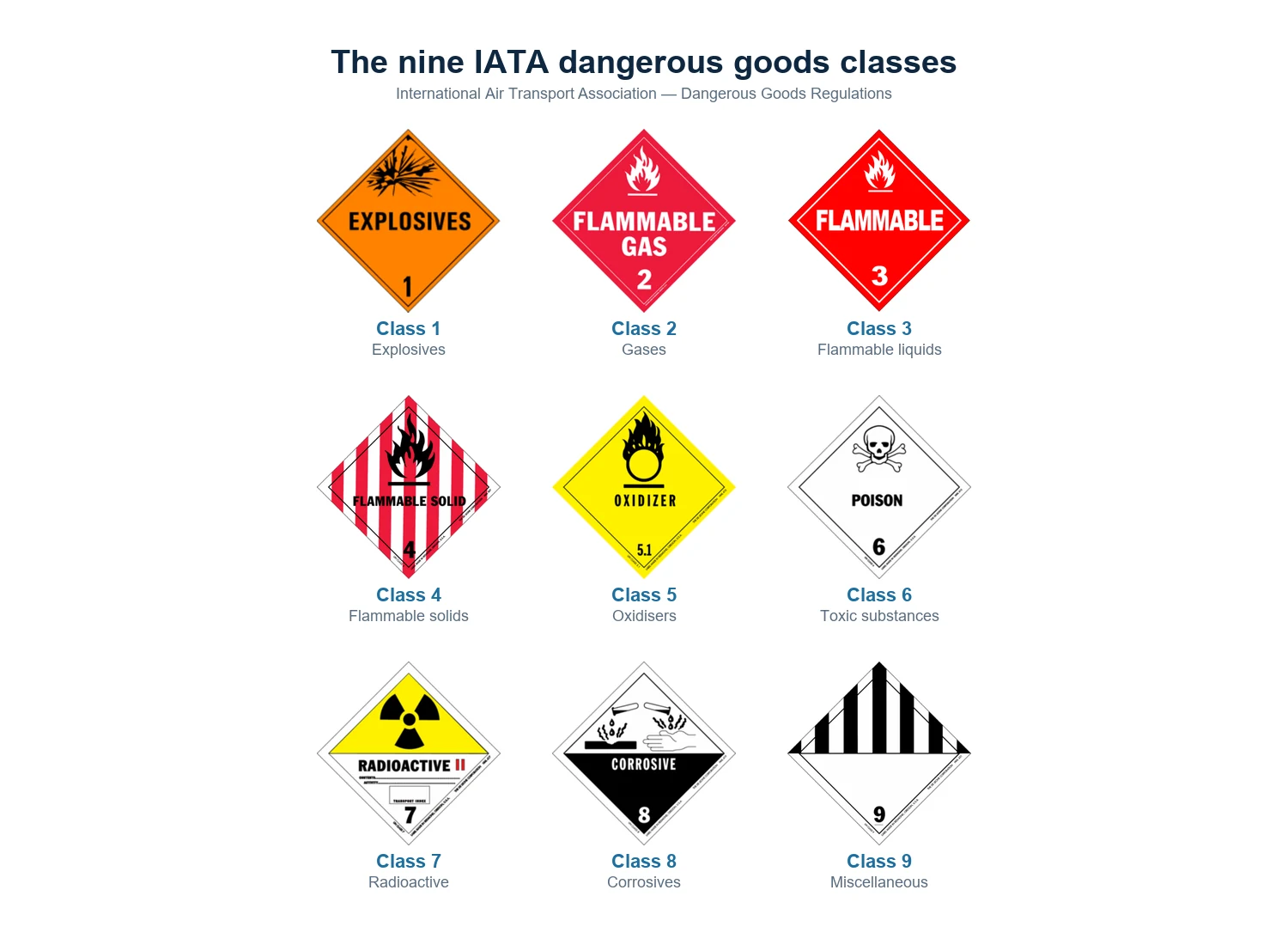
The nine IATA classes
The classification framework comes from the United Nations Model Regulations and is adopted unchanged by IATA for air carriage. The classes below are universal — every airline and air courier in the world uses them.
Accessible — may be carried on cargo or passenger aircraft with declaration
Inaccessible — strict restrictions, may not be carried on passenger aircraft
Classes not accepted on our network
UN 3373 — diagnostic specimens
Patient diagnostic specimens, blood samples for laboratory testing, and clinical trial material that does not contain Category A pathogens fall under Class 6.2 with the UN number 3373 — "Biological Substance, Category B". They are accepted on our network with correct packaging.
- Primary receptacle — watertight, leak-proof container holding the specimen
- Secondary packaging — watertight, leak-proof, with absorbent material between the primary and secondary capable of soaking up the entire primary contents
- Outer packaging — rigid, with the UN 3373 diamond mark and "Biological Substance, Category B" wording, sized to withstand a 1.2 m drop test
Lithium batteries — the special case
Lithium-ion and lithium-metal batteries are everywhere — in phones, laptops, e-cigarettes, toys, power tools, drones, medical devices, even greeting cards with light-up features. They are all Class 9 dangerous goods. The shipping rules depend on whether the battery is loose, packed with equipment, or installed inside equipment, and on its watt-hour rating (lithium-ion) or lithium content (lithium-metal).
The four UN numbers
| UN # | Chemistry | Configuration | Common examples |
|---|---|---|---|
| UN 3480 | Lithium-ion | Loose batteries shipped alone | Spare laptop batteries, power banks shipped on their own |
| UN 3481 | Lithium-ion | Packed with, or inside, equipment | Laptops, phones, cameras, tablets, drones |
| UN 3090 | Lithium-metal | Loose batteries shipped alone | Spare button cells (specific to lithium-metal chemistry) |
| UN 3091 | Lithium-metal | Packed with, or inside, equipment | Watches, smoke detectors, hearing aids, calculators |
The four sections
Each UN number splits further into Sections IA, IB or II depending on size, quantity per package, and configuration. Higher sections mean more documentation.
Section IA
Largest cells/batteries above standard thresholds. Full dangerous-goods documentation including Shipper's Declaration. Class 9 lithium battery label and "Cargo Aircraft Only" mark. Trained shipper required.
Section IB
Smaller cells/batteries below the Section IA size thresholds but in larger package quantities than Section II allows. Reduced documentation but still requires Class 9 label and Cargo Aircraft Only mark.
Section II
Smallest cells, in limited quantities per package, inside or with equipment. No Shipper's Declaration required but lithium battery handling mark and shipper's responsibility statement still apply.
Section II thresholds
- Lithium-ion: ≤ 20 Wh per cell and ≤ 100 Wh per battery
- Lithium-metal: ≤ 1 g lithium content per cell and ≤ 2 g per battery
- Package quantity within the IATA limits for that specific UN number / section
- Batteries inside or packed with equipment (UN 3481 / UN 3091) — Section II is generally not available for batteries shipped alone
State of charge
Stand-alone lithium-ion batteries (UN 3480) must be shipped at ≤ 30% state of charge. This is a hard IATA rule intended to limit the energy available in a thermal-runaway event. It does not apply to batteries inside or with equipment.
How to declare DG with Interdoc
Our online quote engine does not currently handle dangerous-goods bookings end-to-end — there are too many variables (origin/destination acceptance, packing instruction, training requirements) for an automated flow to do safely. All DG shipments are handled as manual exceptions.
- The Safety Data Sheet (SDS) for the product
- UN number, proper shipping name, class and packing group
- Net quantity per package and number of packages
- Origin and destination addresses
- Confirmation of whether the consignor has IATA DG training (or whether we should arrange a Regulated Agent on your behalf)
Frequently asked questions
What are dangerous goods?
What are the nine IATA dangerous goods classes?
How do I know if my item is a dangerous good?
Can I ship a laptop or phone internationally?
What is UN 3373?
What dangerous goods does Interdoc refuse?
Why must lithium-ion batteries ship at 30% charge?
Sources & attributions
The dangerous-goods classification framework is set by the United Nations and adopted unchanged by IATA and ICAO. Every airline and air courier on earth uses the same nine classes, the same UN numbers, the same packing instructions and the same lithium-battery section structure — this is the canonical international system with no proprietary alternative.
Primary upstream sources
- IATA Dangerous Goods Regulations — current edition (annual revision)
- ICAO Technical Instructions for the Safe Transport of Dangerous Goods by Air, Doc 9284
- UN Model Regulations on the Transport of Dangerous Goods — "Orange Book" recommendations
- IATA Lithium Battery Guidance Document — Sections IA / IB / II thresholds and shipping rules
- UN Manual of Tests and Criteria — basis for lithium-battery state-of-charge limits
Industry standards & terminology
- Nine UN/IATA hazard classes — universal taxonomy (Class 1 Explosives through Class 9 Miscellaneous)
- UN 3373 (Biological Substance, Category B) + Packing Instruction P650
- UN 3480 / 3481 / 3090 / 3091 — lithium-battery nomenclature
- Section IA / IB / II — universal lithium-battery threshold framework
- 100 Wh / 20 Wh / 1 g / 2 g — universal Section II cutoffs
- 30% state-of-charge limit for UN 3480 stand-alone lithium-ion
- Accessible vs inaccessible DG distinction — ICAO Technical Instructions
All original prose, explanations and the "how to declare DG with Interdoc" workflow on this page are the original work of Interdoc and have been verified against publicly indexed web content as not derived from any specific carrier's documentation.