
InterdocInternational courier
Shipping guide Section 05 Prohibited items

What we cannot ship.

Aviation security regulations, international customs rules and basic safety mean some items will not move through our carrier network under any circumstances. Other items can move, but only with prior authorisation, the correct paperwork or an export permit. This page is the working list.

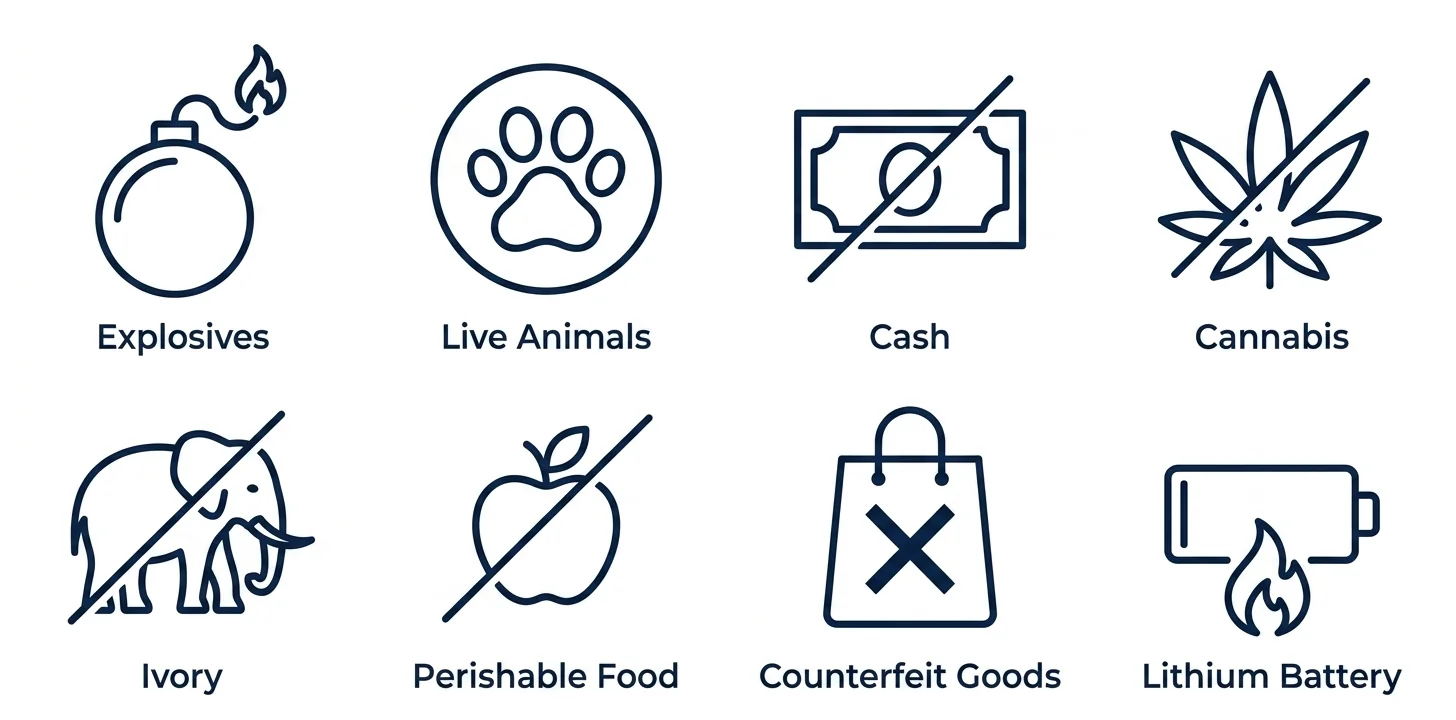
Icon grid of prohibited shipment categories: explosives, live animals, cash, cannabis, ivory, perishables, counterfeit goods.
What we never accept.
⚠️
If a prohibited item enters our network without our knowledge and is discovered downstream, we cannot pay you out for it. Our default liability cover is also voided. The carrier may dispose of the item, return it at the sender's cost, or hand it to the relevant authority. This applies whether you knew the item was prohibited or not.

🚫 Prohibited — never accepted

The list below is filterable and searchable. Type a word (e.g. "battery", "alcohol", "currency") or click a category to narrow the list. Where an item is prohibited because of an upstream rule, the source is named in brackets.

WeaponsFirearms, ammunition and component parts (any complete or partial firearm; bullets, primers, propellants)
WeaponsReplicas, imitation firearms, items resembling explosive devices (including novelty grenades)
Weapons3D-printer files or machines for firearm manufacture
ExplosivesExplosives, fireworks, pyrotechnics, incendiary devices (IATA Class 1 dangerous goods)
MilitaryMilitary hardware requiring an export-control licence
Human remainsHuman corpses, organs, embryos, body parts, cremated or disinterred remains (specific exceptions exist for diagnostic specimens — contact us)
Live animalsLive animals of any kind — pets, insects, fish, reptiles
Dead animalsAnimal carcasses, mounted animals, hunting trophies
Animal productsIvory and ivory products, raw furs, untreated animal hides (CITES-controlled)
PlantsLive plants, seeds, soil, cuttings, plant material
PerishablesPerishable or temperature-sensitive food (fresh meat, dairy, fruit, vegetables, cooked food)
PerishablesRefrigerated or frozen items (we do not offer a cold-chain service)
CurrencyCash and legal-tender currency (rand, foreign notes, coins)
CurrencyBearer cheques, money orders, bonds, share certificates payable to bearer
CurrencyCollectable coins, philatelic stamps, gold and silver bullion
CounterfeitCounterfeit currency, goods, branded items, documents
StonesLoose precious and semi-precious stones (unset diamonds, rubies, emeralds)
CannabisCannabis, marijuana (recreational or medicinal)
CannabisCBD products with THC content above 0.3% dry weight, synthetic cannabinoids
CannabisRaw or unrefined hemp plant material
DrugsNarcotics and controlled substances
TobaccoTobacco and tobacco products (cigarettes, cigars, loose tobacco, smokeless tobacco, hookah, shisha)
VapingElectronic cigarettes, vape devices, vape liquids and gels
HazardUndeclared dangerous goods (see DG page; declared DG may move with the correct authorisation)
HazardLoose lithium batteries shipped on their own (UN 3480 / UN 3090 outside equipment)
HazardWet ice / frozen water as a coolant
HazardMedical waste, used or damaged batteries, used fluorescent bulbs
HazardChemical, nuclear or biohazardous waste
AdultPornography, obscene or sexually explicit material
AdultMaterial that is religiously or culturally offensive to the destination country
GamblingGambling devices and illegal lottery tickets
ConditionWet, leaking, foul-smelling or inadequately packed parcels
CustomsUndeclared excisable goods or items exceeding declared customs value
PermitsItems requiring an export or import permit that has not been obtained

⚠️ Restricted — accepted with conditions

These items can move on our network but require either an export / import permit, prior authorisation from us, or specific documentation. Contact us before booking so we can confirm acceptance for the exact origin / destination pair.

AlcoholAlcoholic beverages — destination-dependent; many countries restrict to specific carriers or require import licences. Always declared on commercial invoice.
AerosolsAerosols, perfumes, fragrances — typically IATA Class 3 or 2.2 dangerous goods. Declaration required.
MedicinesPrescription medicines and pharmaceuticals — destination customs rules vary widely; some require import licence.
CosmeticsCosmetics and toiletries with flammable solvents — may be DG Class 3 depending on flashpoint.
ChemicalsChemicals and chemical products — Material Safety Data Sheet required; may need export / import permits.
BatteriesLithium batteries inside or with equipment — IATA Section IA / IB / II rules apply; see DG page.
BatteriesOther battery types (lead-acid, nickel-cadmium) — DG declaration usually required.
MagneticMagnetised materials (UN 2807) — IATA reporting may apply depending on field strength.
Dry iceDry ice (UN 1845) — Class 9 DG, packaging and declaration rules apply; may not be available on all routes.
WildlifeWildlife products under CITES — most are prohibited; permitted species need CITES permits from both export and import countries.
AntiquesAntiques and works of art — export licence often required from origin country; liability cover capped (see liability page).
JewellerySet jewellery and watches — accepted but with capped liability; consider declared-value cover.
DefenceDual-use items under export-control regulations — strategic-export licence required.
DiagnosticDiagnostic specimens (UN 3373) — accepted with Packing Instruction 650 packaging and Category B markings.

📋 If you are unsure

Most "is this allowed?" questions can be answered by checking three things: (1) the IATA Dangerous Goods Regulations classification, (2) the destination country's import rules, and (3) the South African Revenue Service's export rules. We do this routinely as part of every booking — but you can save time and avoid a refused-at-collection situation by emailing us first.

📧
Email admin@interdoc.co.za with:
  • What the item is and what it is made of
  • How much of it (weight and quantity)
  • Origin and destination (cities)
  • Whether it is for personal or commercial use
We respond within one business day with a yes / no / "yes with this permit" answer.

Frequently asked questions

What items can I not ship internationally with Interdoc?
Firearms and ammunition, explosives and fireworks, cash and bearer instruments, cannabis and narcotics, tobacco and vapes, ivory and CITES-controlled wildlife products, live animals, perishable food, human remains, counterfeit goods, loose lithium batteries, and undeclared dangerous goods. Full list on the prohibited items page.
Can I ship a laptop with a lithium battery?
Yes — a laptop with its built-in lithium-ion battery ships under UN 3481 (battery packed with or inside equipment), Section II if the battery is ≤ 100 Wh. Loose lithium batteries shipped on their own (UN 3480 / UN 3090) are not accepted on our standard service.
Can I ship alcohol internationally?
Restricted, not prohibited. Destination-dependent — many countries restrict alcohol to specific carriers or require import licences. Must be declared on the commercial invoice. Contact us before booking with origin, destination and the type and volume of alcohol.
Can I ship cosmetics, perfumes or aerosols?
These are typically IATA Class 3 (flammable liquid) or Class 2.2 (non-flammable gas) dangerous goods because of their flashpoint or aerosol propellant. Restricted, not prohibited, but require formal DG declaration and packaging. Email us for a manual DG quote.
Why are loose lithium batteries banned but laptops aren't?
Loose lithium batteries (UN 3480 / UN 3090 shipped on their own) pose a fire risk in transit that the standard service cannot manage. Batteries inside equipment or packed with equipment (UN 3481 / UN 3091) fall under reduced Section II rules and are accepted under specific Wh and quantity thresholds.
What happens if I accidentally ship a prohibited item?
If a prohibited item enters our network without our knowledge and is discovered downstream, we cannot pay you out for it. Default liability cover is voided. The carrier may dispose of the item, return it at the sender's cost, or hand it to the relevant authority — whether you knew it was prohibited or not.

📚 Sources & attributions

The prohibited and restricted item lists on this page are compiled from international aviation, customs and species-protection authorities. They represent the universal carrier-network position — no carrier in our partner network is permitted to ship the items in the prohibited list.

Primary upstream sources

Industry standards & terminology

All original prose, explanations and category groupings on this page are the original work of Interdoc and have been verified against publicly indexed web content as not derived from any specific carrier's documentation.