
Fuel surcharge
Every international air carrier in the world applies a fuel surcharge, adjusted regularly against the published spot price of kerosene-type jet fuel on the U.S. Gulf Coast (the global reference benchmark). The surcharge is a percentage applied on top of the base transportation rate.
The fuel surcharge applies not only to the base rate but also to most transportation-related surcharges (address correction, handling, signature, oversize, dangerous goods, Saturday, demand). It does not apply to declared-value charges, duties or taxes.
Security surcharge
Air cargo originating in South Africa is subject to mandatory security screening under the South African Civil Aviation Regulations 1997, Part 108. The regulation applies to all parties involved in the acceptance, forwarding, storage and carriage of cargo by air — no exceptions.
Two routes to compliance:
- Known Consignor — an organisation accredited by SACAA to apply prescribed security controls at origin. Cargo from a Known Consignor moves with reduced re-screening.
- Unknown Consignor — cargo not from an accredited Known Consignor must be 100% physically or technically screened (X-ray, explosive trace detection) before loading onto an aircraft.
Remote-area surcharge
Carrier networks define "main centres" — typically urban areas within 50 km of a major hub airport. Deliveries (and collections) outside these main centres carry a remote-area surcharge to cover the additional last-mile cost.
South Africa — main centres typically covered without surcharge
Johannesburg, Pretoria, Vaal Triangle, Rustenburg, Polokwane, Nelspruit, Witbank, Durban, Pietermaritzburg, Richards Bay, Cape Town, Stellenbosch, George, Port Elizabeth, East London, Bloemfontein, Kimberley.
Areas outside the 50 km radius of these main centres attract a remote-area surcharge. International remote-area surcharges work the same way for destinations.
Handling & size-related surcharges
These apply to parcels that fall outside the standard sorting envelope. If your shipment triggers any of these, our quote engine flags it before checkout — but it's useful to understand the underlying triggers so you can avoid them where possible.
| Surcharge | Trigger | Avoidance |
|---|---|---|
| Oversize / large-package | Any single side > 120 cm, or L + G > 274 cm | Repack into smaller cartons where possible |
| Overweight (per piece) | Single piece > 23 kg on ICP service | Use multiple cartons; book freight quote if total > 23 kg/piece is needed |
| Additional handling — dimensions | Parcels that cannot pass on a standard sorter belt (long thin, very heavy for size) | Cubic, evenly-distributed weight in standard cartons |
| Additional handling — weight | Single piece > 32 kg (industry standard for "manual handling" trigger) | Below 23 kg ICP cap, this should never trigger |
| Non-stackable | Freight pieces that cannot be safely stacked under another | Pack to allow stacking; reinforce with crating |
| Non-conveyable | Round, slippery, or odd-shape parcels that cannot move on automated sorters | Use rectangular outer cartons even for irregular contents |
Service-related surcharges
| Surcharge | Trigger |
|---|---|
| Address correction | Recipient address is incomplete or invalid and the carrier has to chase the correct address |
| Signature — direct | You opt to require the addressee personally to sign |
| Signature — adult | You opt to require a signature from a person aged 21+ (alcohol, age-restricted goods) |
| Saturday delivery | Delivery on a Saturday in markets that offer this; not available everywhere |
| Saturday pickup | Collection from your premises on a Saturday |
| Demand / peak surcharge | Carrier-imposed during high-demand periods (e.g. Q4 / pre-Christmas, post-pandemic capacity peaks) |
| Dangerous goods | Per shipment, varies by class (accessible / inaccessible / dry ice / consumer commodity ID 8000) |
| Broker selection | You nominate a non-network customs broker for clearance |
| Restricted destination | Shipment to a country under OFAC / UN sanctions or restricted-trade list |
| Unauthorised package | Package tendered without prior carrier authorisation (rare on retail Interdoc bookings) |
Customs & documentation fees
Ancillary clearance fee
When the carrier advances duty and tax on the recipient's behalf at destination, an ancillary clearance fee applies (typically a flat fee or a small percentage of the advanced amount).
Data entry fee
If shipping data is submitted on paper instead of electronically, an additional handling fee applies. Our system is electronic end-to-end, so this rarely applies to Interdoc shipments.
Disbursement fee
Some destination customs brokers add a disbursement fee for handling the duty/VAT payment process. This is collected from the recipient with the duty.
Documentation & liability fee (domestic)
For domestic SA shipments, a small fee provides automatic cover up to R 1 000 for non-consequential damage or loss. Customers can opt out.
Late payment
Overdue invoices accrue interest at a rate above the relevant central bank reference rate, plus a liquidated-damages charge. The exact terms appear on your invoice; the principle matches the international air-freight industry standard for account customers. Retail Interdoc bookings paid at checkout are not affected.
How to read a quote
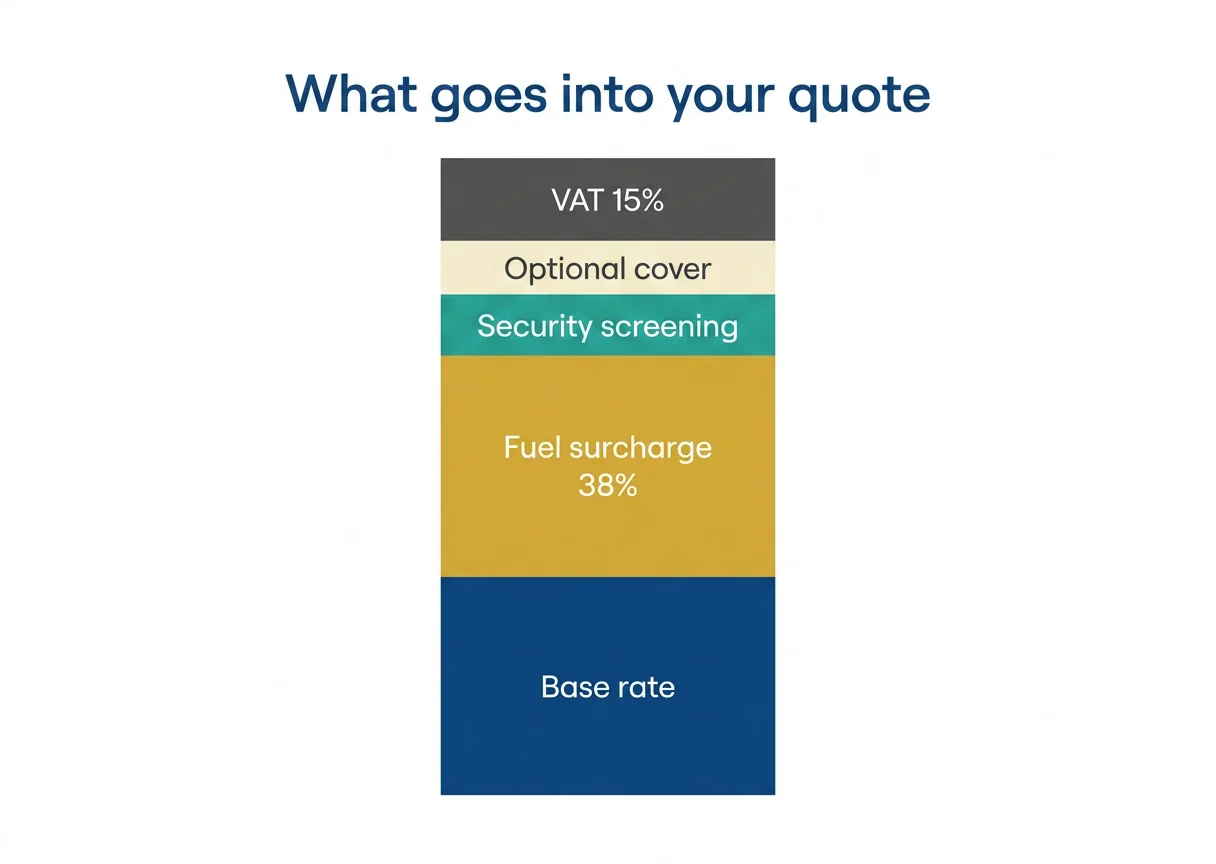
Every Interdoc quote breaks the charges down into the same line items. From top to bottom:
Base rate
- What
- Origin → destination transportation
- Based on
- Service tier (ICD/ICP), billable weight, destination zone
Fuel surcharge
- What
- Percentage of base + most other line items
- Based on
- Current week's USGC jet fuel index
Security surcharge
- What
- Per chargeable kg, for air cargo screening
- Based on
- SA Civil Aviation Regulation 1997 Part 108
Specific surcharges (if triggered)
- What
- Remote area, oversize, additional handling, etc.
- Based on
- Address and parcel dimensions
Optional cover
- What
- Declared-value or insurance add-on
- Based on
- Declared shipment value
VAT
- What
- South African VAT on Interdoc service fee
- Based on
- 15% — applies on domestic portion; international service is zero-rated
Frequently asked questions
Why is there a fuel surcharge on my quote?
What is the security surcharge for?
What is a Known Consignor?
What triggers a remote-area surcharge?
Why was my parcel charged an oversize fee?
Is VAT charged on international shipments?
Sources & attributions
Surcharge categories on this page derive from South African aviation security law, the universally-used USGC jet-fuel price index, and the standard carrier-network ancillary fee schedule. Where regulation text is quoted (Civil Aviation Reg 1997 Part 108) it is reproduced under the public-domain convention that applies to all South African legislation.
Primary upstream sources
- South African Civil Aviation Regulations 1997, Part 108 — gazetted via Regulation Gazette 8668; effective 1 July 2009; air-cargo security screening requirements
- South African Civil Aviation Authority (SACAA) Aviation Security Office — Known Consignor / Unknown Consignor framework
- US Energy Information Administration (EIA) — USGC kerosene-type jet fuel weekly spot price index (universal global fuel-surcharge reference)
- European Commission DG Transport & Energy — European diesel price reference (used by some carriers for domestic surcharge)
Industry standards & terminology
- Industry-standard fuel surcharge mechanism (USGC indexation, weekly or monthly review)
- Known Consignor / Unknown Consignor framework — ICAO Annex 17 derived
- Carrier-network common ancillary fee categories (address correction, oversize, additional handling, signature)
- De minimis customs threshold concept (varies by destination)
All original prose, explanations, examples and the "how to read a quote" walkthrough on this page are the original work of Interdoc and have been verified against publicly indexed web content as not derived from any specific carrier's documentation.