
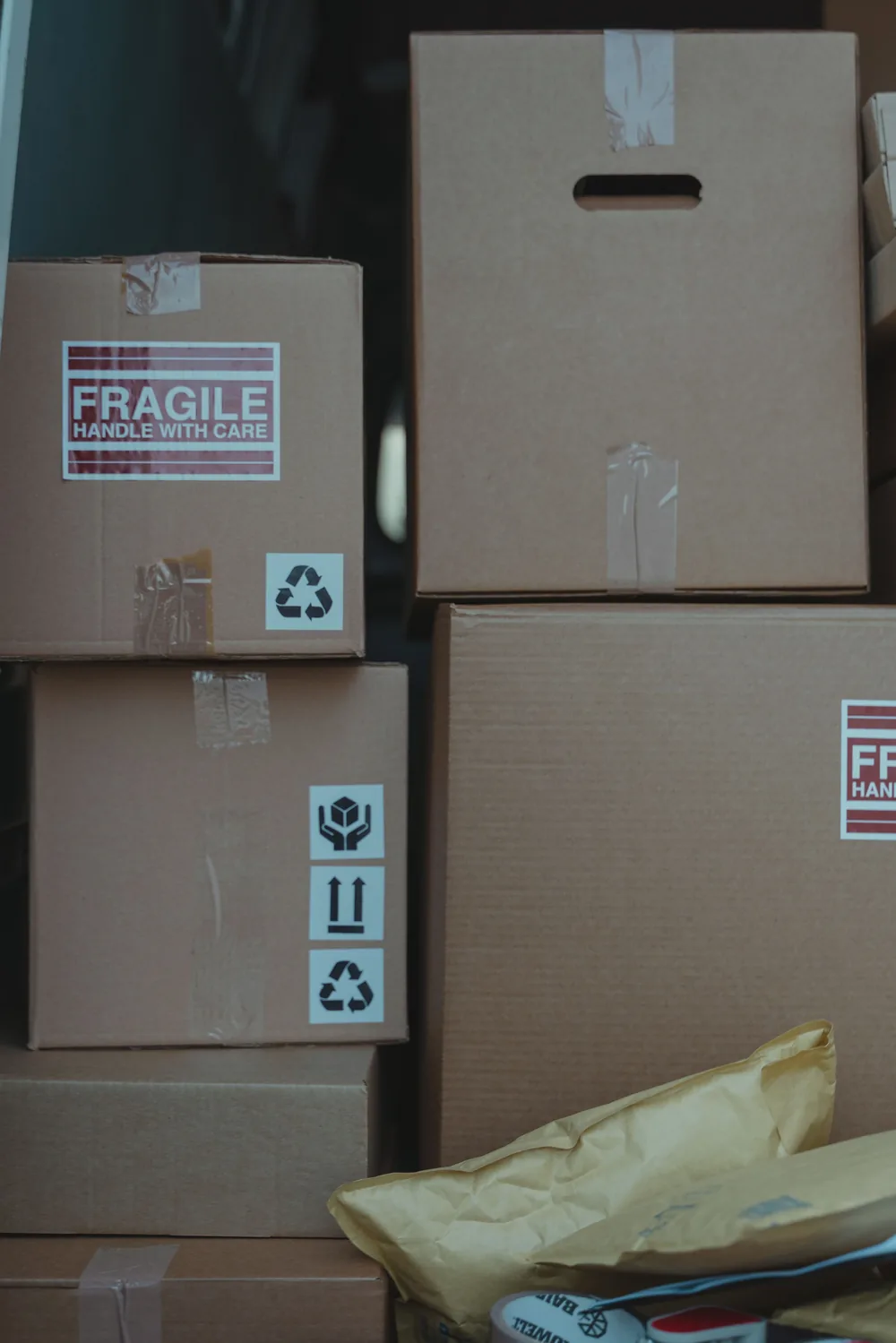
Choose the right carton
Rigid, single-use, double-walled cartons
A new corrugated box with intact edges and no soft spots. Double-wall (5-ply) is the right choice for anything over 5 kg or any fragile content.
Right-sized for the contents
Just large enough to fit the goods with 2–3 cm of cushioning on every side. Oversize cartons are expensive (volumetric weight) and unsafe (contents shift).
Re-used cartons with old labels
Carriers scan multiple labels and route by the freshest barcode they find — old labels cause misdelivery. They also indicate weakened structure. Use a fresh box.
Soft-edge or punctured cartons
A carton with a crushed corner has lost most of its structural strength. A punctured wall is a guaranteed leak path for cushioning material.
Lightweight gift boxes as outer
Decorative single-walled gift boxes are an inner container only. Always pack them inside a stronger outer carton with cushioning between.
Plastic carrier bags or sacks
Refused at collection. The network requires rigid outer packaging — soft containers cannot pass over sorting belts safely.
Cushioning & void fill
The aim is simple: nothing inside the carton should be able to move when you shake it. The shipment will be stacked, tilted, dropped and vibrated; loose contents accelerate into the carton walls each time. Two-finger rule — your finger should not fit between any item and a carton wall when the box is sealed.
Materials, ranked
| Material | Best for | Notes |
|---|---|---|
| Bubble wrap (small-bubble) | Most fragile goods, surface protection | Wrap each item separately, two layers minimum. Tape the seams. |
| Air pillows | Void fill around fragile items | Reliable cushioning at minimal volumetric weight; the modern standard for e-commerce parcels. |
| Polystyrene chips | Void fill, mid-density | Good cushioning but can shift. Fill to the brim and tape the lid down with no air gap. |
| Crumpled kraft paper | Cushioning soft items, eco-friendly | Crush each sheet to dimensional density first. Solid paper sheets do not cushion. |
| Custom foam inserts | High-value or one-of-a-kind items | Engineered protection. Worth the time for electronics, instruments, art. |
| Newspaper | Last resort only | Almost no cushioning effect. Ink can transfer onto goods. Use proper materials. |
The H-tape seal
The H-tape method is the only sealing pattern that reliably holds a carton closed under sorting-belt impact and stacking pressure. It is named for the H-shape the tape forms across the lid: one strip along the centre seam, two strips across the perpendicular flap seams. Repeat on the bottom of the carton.
Tape type
Pressure-sensitive plastic packing tape, at least 5 cm wide (7.5 cm preferred). Two layers on every seam.
Pattern
One strip across the long seam, then one strip each across both end-flap seams. Each strip runs at least 5 cm down each side panel.
Do not use
Cellophane tape, masking tape, duct tape, kraft-paper tape, string, rope. All fail under network handling.
Labelling
The Interdoc waybill is generated automatically at checkout and emailed to you as a PDF. Print at A4 (the layout has two perforated copies on one page with a scissors-icon cut line between them). Attach one copy to the parcel using the waybill pouch or with clear packing tape over the whole label (do not tape over the barcode itself — laminate around it).
- Single label, clearly visible, on the largest face of the carton
- Barcode unobstructed — no tape, no shrink-wrap, no stickers across it
- Remove or completely cover all old labels and barcodes from previous shipments
- Include a copy of the commercial invoice inside the parcel for ICP shipments (one set outside, one inside)
- If the parcel needs orientation (e.g. liquids "this way up"), add a printed "this way up" arrow on two sides — but do not rely on it
Fragile items — special care
Some categories deserve extra attention because they fail in characteristic ways and are excluded from default carrier liability cover. See the liability page for the exclusions list.
Glassware, ceramics, mirrors
Electronics — laptops, phones, cameras
Liquids, gels, creams
Artwork, paintings, framed items
Documents — sensitive paperwork
Quick checklist
- Carton is rigid, new or near-new, double-walled if over 5 kg
- Contents wrapped individually; nothing can move when shaken
- Cushioning on every side, at least 2–3 cm thick
- Liquids in sealed bags with absorbent material
- H-tape seal on top and bottom with 5 cm+ plastic tape
- Old labels removed or fully covered
- Waybill attached, barcode unobstructed
- Commercial invoice (one outside, one inside) for ICP
Frequently asked questions
What is the H-tape sealing method?
What kind of tape should I use?
Should I use a single-walled or double-walled box?
How much cushioning should I use?
How do I pack liquids for international shipping?
How should I attach the waybill?
Sources & attributions
Packaging guidance on this page is compiled from international packaging standards, drop-test conventions, and general best practice used universally across the international parcel courier industry. The H-tape method and the recommended materials are industry-standard with no proprietary alternative.
Primary upstream sources
- IATA / ICAO general packaging guidelines — air-cargo packaging conventions
- ASTM D5276 / ISO 2206 — drop-test standards (basis for the "drop from waist height" expectation)
- IATA Packing Instructions — fragile-item and dangerous-goods packaging (P650, P965, P968 etc.)
- UN Model Regulations — packaging performance levels for hazardous shipments
Industry standards & terminology
- H-tape sealing method — universal carrier-network convention
- Double-walled (5-ply) corrugated carton — ECT-44 industry standard
- Pressure-sensitive plastic tape ≥ 5 cm wide — industry minimum
- "This way up" arrow icon — international ISO 7000-0623 pictogram
All original prose, analysis, examples and packing recommendations on this page are the original work of Interdoc and have been verified against publicly indexed web content as not derived from any specific carrier's documentation.