The commercial invoice
The commercial invoice is the single most important customs document. It is the proof of the transaction, the basis on which duties are calculated, and the document that customs officials check before releasing the parcel. Every non-document international shipment needs one. Documents (ICD service) do not.
Customs authorities typically want one original plus two copies, each individually signed. We recommend one copy goes inside the parcel; the others travel with the waybill on the outside.
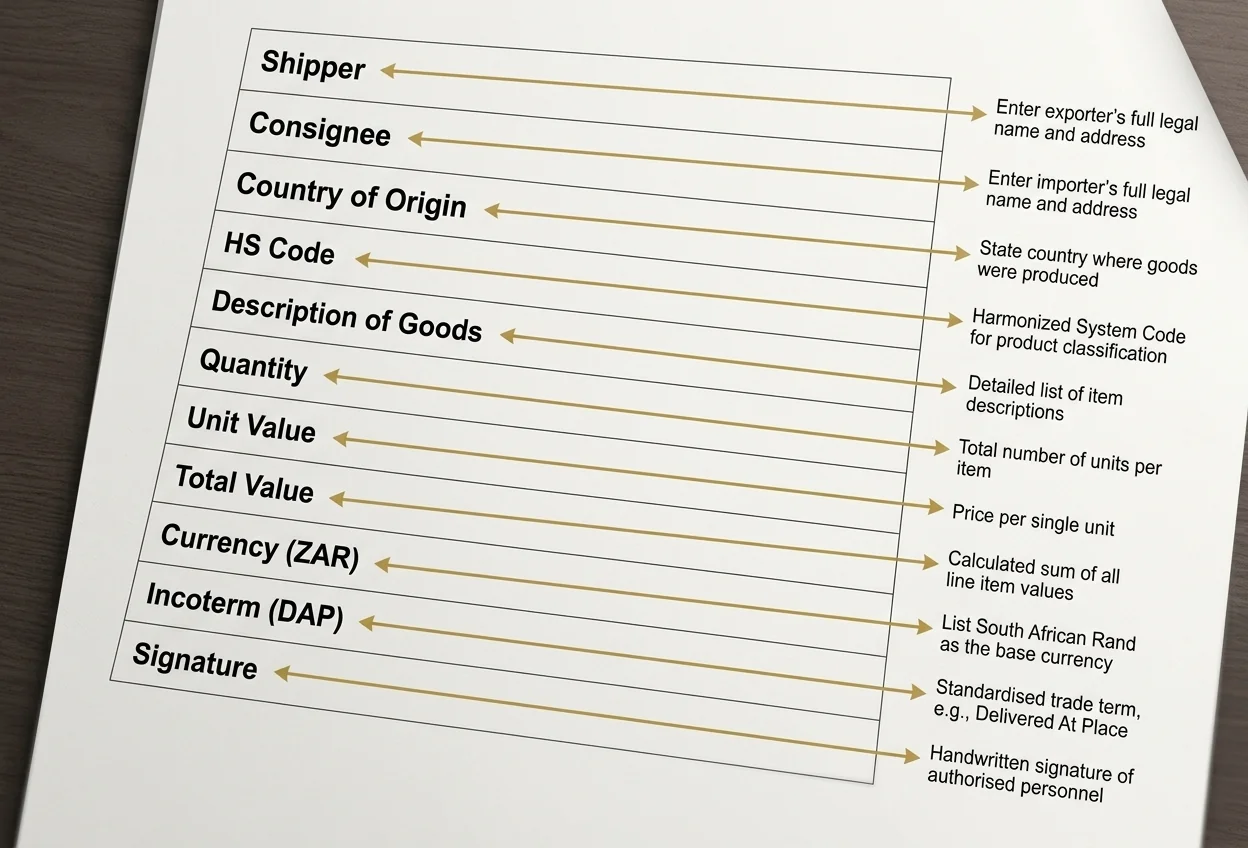
Required fields
| Field | What to put |
|---|---|
| Shipper / exporter | Your full company name, physical address, contact name, telephone, email, VAT registration number where applicable. |
| Recipient / consignee | Full name, complete physical address with postal code, mobile number in international format, tax identification number where required by the destination. |
| Country of origin | Where the goods were manufactured, not where they are being shipped from. If multiple items have different origins, list per item. |
| HS code | The 6-digit (or longer) Harmonized System code for each item. See HS code section below. |
| Description | Specific. "10 boxes of stainless-steel screws for civil aircraft" — not "aircraft parts". State what the item is, what it is made of, and what it will be used for. |
| Quantity | Number of units of each line item, plus total quantity and total weight per item and shipment. |
| Unit value & total value | Per item, then totalled. Use the actual transaction price, not zero, even for samples or warranty returns. |
| Currency | Three-letter ISO code (ZAR, USD, EUR, GBP). The "$" symbol on its own is insufficient — several countries use it. |
| Reason for export | Sale, gift, sample, repair, return, replacement under warranty — be specific. |
| Incoterm | Typically DAP (Delivered at Place — recipient pays duty) for parcels. See the Incoterms section below. |
| Waybill number | The Interdoc waybill / tracking number, so customs can cross-reference. |
| Signature & date | Each copy individually signed by the shipper, certifying contents are true and correct. |
HS codes (Harmonized System)
The Harmonized System is the international classification language for traded goods. Maintained by the World Customs Organisation and used in over 140 countries, it covers more than 5 600 commodity groups. The first six digits are universal — countries add national digits to reach 8 or 10 digits for their own tariff books. South Africa uses 8-digit codes; the United States uses 10.
Structure
- Digits 1–2
- Chapter (96 chapters)
- Digits 3–4
- Heading
- Digits 5–6
- Subheading (universal)
- Digits 7–8+
- National extension
Used for
- Tariff
- Determining duty rate
- Origin
- Applying preferential rules
- Restrictions
- Permits, quotas, controls
- Statistics
- National trade data
For most parcels we file the 6-digit international code on the commercial invoice. If you know the destination country's full 8- or 10-digit code, include it — clearance is faster.
Duties, taxes & Incoterms
The destination country charges import duty (a tariff based on the HS code) plus VAT or sales tax on most commercial shipments. Who pays these charges depends on the Incoterm declared on the commercial invoice. The two relevant for parcel courier are DAP (the recipient pays) and DDP (the sender pays).
| Incoterm | Full name | Who pays duty & tax? | When to use |
|---|---|---|---|
| DAP Default | Delivered at Place | Recipient | Default for our network. The recipient pays import duty and VAT to the local customs broker before release. |
| DDP | Delivered Duty Paid | Sender | You want the recipient to receive the parcel with no payment to make. Available on selected routes for an additional fee. Contact us. |
| DDU (legacy) | Delivered Duty Unpaid | Recipient | Older term, replaced by DAP in Incoterms 2010. Many customers still use it colloquially; treat as equivalent to DAP. |
| EXW / FOB / CIF | (Sea / freight terms) | Various | Relevant for sea-freight and larger commercial shipments — generally not for parcel courier. |
De minimis — when duty doesn't kick in
Most countries set a "de minimis" threshold — a value below which imports are exempt from duty. The thresholds vary widely:
- South Africa imports: The historic R500 informal-clearance threshold has effectively been removed for cross-border e-commerce parcels — duty and 15% VAT now apply on most commercial shipments regardless of value.
- United States imports (effective 29 August 2025): The duty-free de minimis exemption for commercial shipments up to USD 800 has been removed. All commercial parcels to the US now attract duty, regardless of value or country of origin.
- United Kingdom: Threshold of £135 for low-value consignments; over that, full duty and VAT apply.
- European Union: €150 for duty; VAT applies on all commercial shipments.
- Australia: AUD 1 000 for duty; GST applies on all commercial shipments.
SARS — South African export requirements
The South African Revenue Service requires every exporter to be registered in advance. For occasional senders (gifts, personal effects) this is light-touch; for commercial exporters it is substantial.
SARS eFiling
All customs trader interactions go through the SARS eFiling Customs Trader Portal. Registration is free. Most senders we work with already have an eFiling profile from VAT or income tax.
RLA registration
Registration, Licensing and Accreditation — required for importers, exporters, clearing agents and warehouses. The portal is online; quick-guide SC-CF-42 walks through the process.
Record retention
South African customs law requires importers and exporters to keep customs records (invoices, waybills, declarations, supporting documents) for 5 years from the date of release.
SAD 500
The Customs Declaration Form filed for each cross-border movement. Filed by the clearing agent (us or our partners); requires the commercial invoice, packing list and waybill as supporting documents.
Other documents that may be needed
Certificate of Origin
Export / import permits
Phytosanitary certificate
Veterinary health certificate
Packing list
Shipper's Declaration for Dangerous Goods
Importer's Tax Identification Number
Frequently asked questions
What is a commercial invoice and do I need one?
What is an HS code?
What is the difference between DAP and DDP?
What is the US de minimis change for August 2025?
What's the UK low-value consignment threshold?
How long must I keep customs records?
What does SARS require to export from South Africa?
Sources & attributions
Customs procedures, documentation requirements and HS-code structure on this page derive from the World Customs Organization, the International Chamber of Commerce, the South African Revenue Service and the customs authorities of major destination countries. The Commercial Invoice field list and the HS-code structure are universal — no proprietary alternative exists.
Primary upstream sources
- World Customs Organization (WCO) Harmonized System — current edition (HS 2022); 6-digit base + national extensions
- ICC Incoterms 2020 — DAP, DDP, EXW, FOB, CIF and other terms (used under International Chamber of Commerce license framework)
- SARS Customs & Excise Act 91 of 1964 — South African export / import declarations, 5-year record retention
- SARS Customs Trader Portal Quick Guide SC-CF-42 — RLA registration procedure
- US Customs and Border Protection — de minimis policy effective 29 August 2025
- HM Revenue & Customs (UK) — £135 low-value consignment threshold
- European Commission DG Taxation & Customs Union — €150 duty threshold, IOSS scheme
Industry standards & terminology
- Standard Commercial Invoice fields — universal across international customs
- HS code 6-digit base + national 8- or 10-digit extension convention
- DAP / DDP / EXW / FOB / CIF — Incoterm 2020 definitions (ICC)
- "De minimis" — Latin term for value threshold below which duty does not apply
- Certificate of Origin, packing list, SAD 500 — standard customs document set
All original prose, examples, the field-by-field walkthrough and the destination-country guidance on this page are the original work of Interdoc and have been verified against publicly indexed web content as not derived from any specific carrier's documentation.