Delivery procedures
Default — release without signature
Direct signature
Indirect signature
Adult signature
Delivery to "apparent authority"
Undeliverable shipments
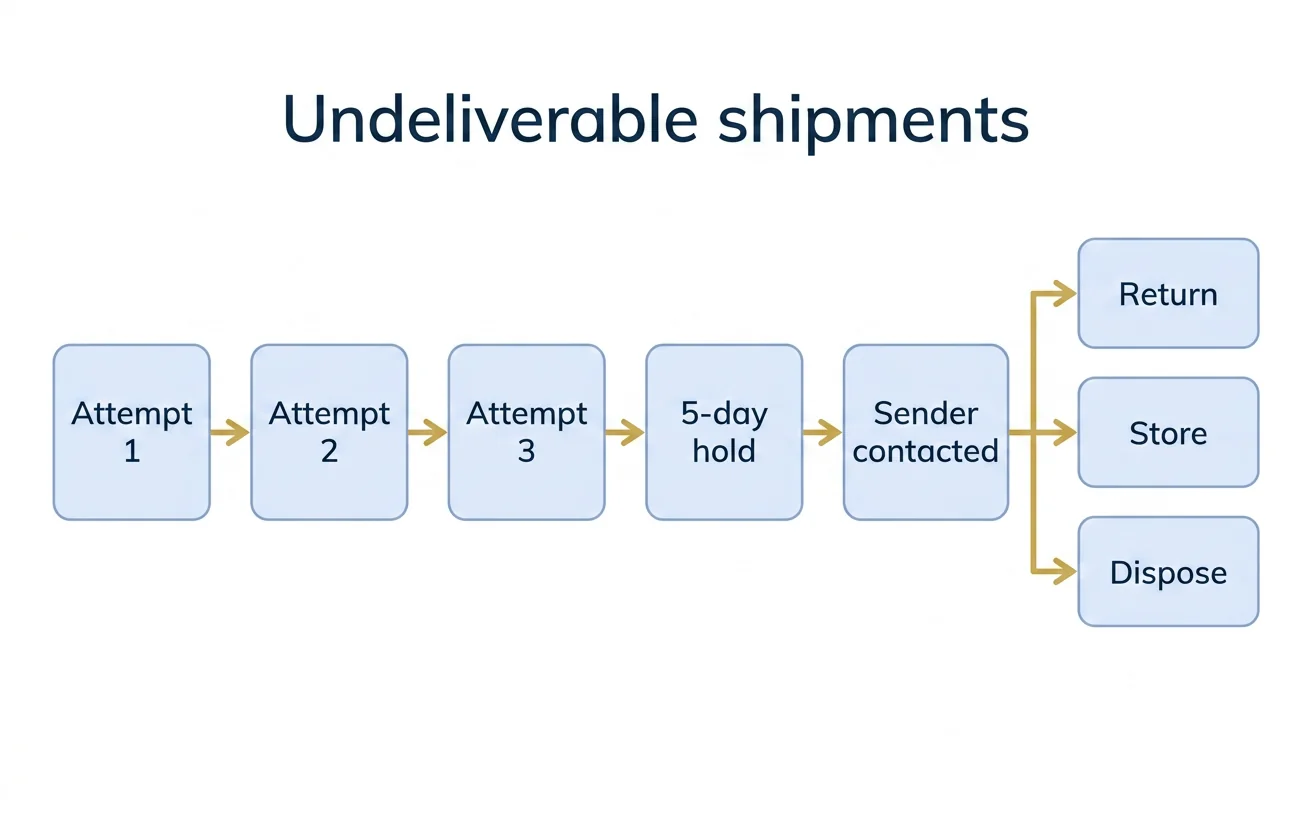
A shipment is treated as undeliverable when the network cannot complete delivery within the standard attempt cycle. The exact rules vary by service tier, but the pattern is consistent.
| Delivery type | Undeliverable when | Then what |
|---|---|---|
| Business address | After 3 attempted deliveries, or after being held 5 business days from first attempt — whichever is sooner | Returned, held at carrier facility, or escalated to sender |
| Residential / B2C | After re-attempts (typically 3), or after being held 5 business days | Held at nearest courier pickup point for collection by the recipient |
| All addresses (alternate) | Address incomplete or wrong, business closed, refusal to accept/sign, customs failure, prohibited items, refusal to pay duty, improper packaging | Escalated to sender for instructions |
Customs abandonment
Customs abandonment is the specific case where the consignee refuses (or is unable) to pay the import duty and VAT on a shipment. Interdoc and the carrier network manage clearance, but cannot release the parcel until duties are paid.
- The destination customs broker holds the shipment for the local storage period (typically 30 days)
- The sender is contacted with three options: pay the duty themselves (DDP conversion), pay for return at their cost, or abandon
- If no decision is made, the customs broker may sell the goods at auction or destroy them, depending on local rules
- The sender is invoiced for all storage, handling and return / disposal costs
Carrier inspection & screening
Right to open and inspect
X-ray and trace screening
Right to refuse
Disposal of leaking or damaged packages
Contact
Website
Track a shipment
Get a quote
Frequently asked questions
Does my parcel need a signature on delivery?
What happens if no one is home for delivery?
What happens if the recipient refuses to pay duty?
Can the carrier open and inspect my parcel?
How does Interdoc handle abandoned shipments?
Can I deliver to someone other than the named recipient?
Sources & upstream references
The information in this guide is compiled from the following authoritative sources:
International conventions
- Montreal Convention 1999 (air carriage liability)
- Warsaw Convention 1929 + Hague Protocol 1955 (legacy air)
- CMR Convention 1956 (cross-border road)
- Hague-Visby Rules (sea, for completeness)
Regulatory bodies
- International Air Transport Association (IATA) — DGR
- International Civil Aviation Organization (ICAO) — TI Doc 9284
- World Customs Organization (WCO) — Harmonized System
- International Chamber of Commerce (ICC) — Incoterms 2020
- International Monetary Fund (IMF) — SDR valuation
South African statutes
- Civil Aviation Regulations 1997, Part 108 (cargo security)
- Customs & Excise Act (record retention, declarations)
- Protection of Personal Information Act 4 of 2013 (POPIA)
- SARS RLA Quick Guide SC-CF-42
Industry standards
- Volumetric weight divisor ÷ 5 000 (air-express convention)
- Volumetric weight divisor ÷ 4 000 (road-express convention)
- Length + girth ≤ 274 cm (industry-common envelope)
- P650 packaging (Biological Substance Category B)
All original prose, analysis, examples and operational guidance throughout this guide is the original work of Interdoc and has been independently verified against publicly indexed web content as not derived from any specific carrier's documentation. Industry-standard terminology (UN numbers, packing instructions, IATA classifications, SDR units, HS codes, Incoterm names) follows the canonical naming used universally across the international transport industry — there are no proprietary alternatives.