
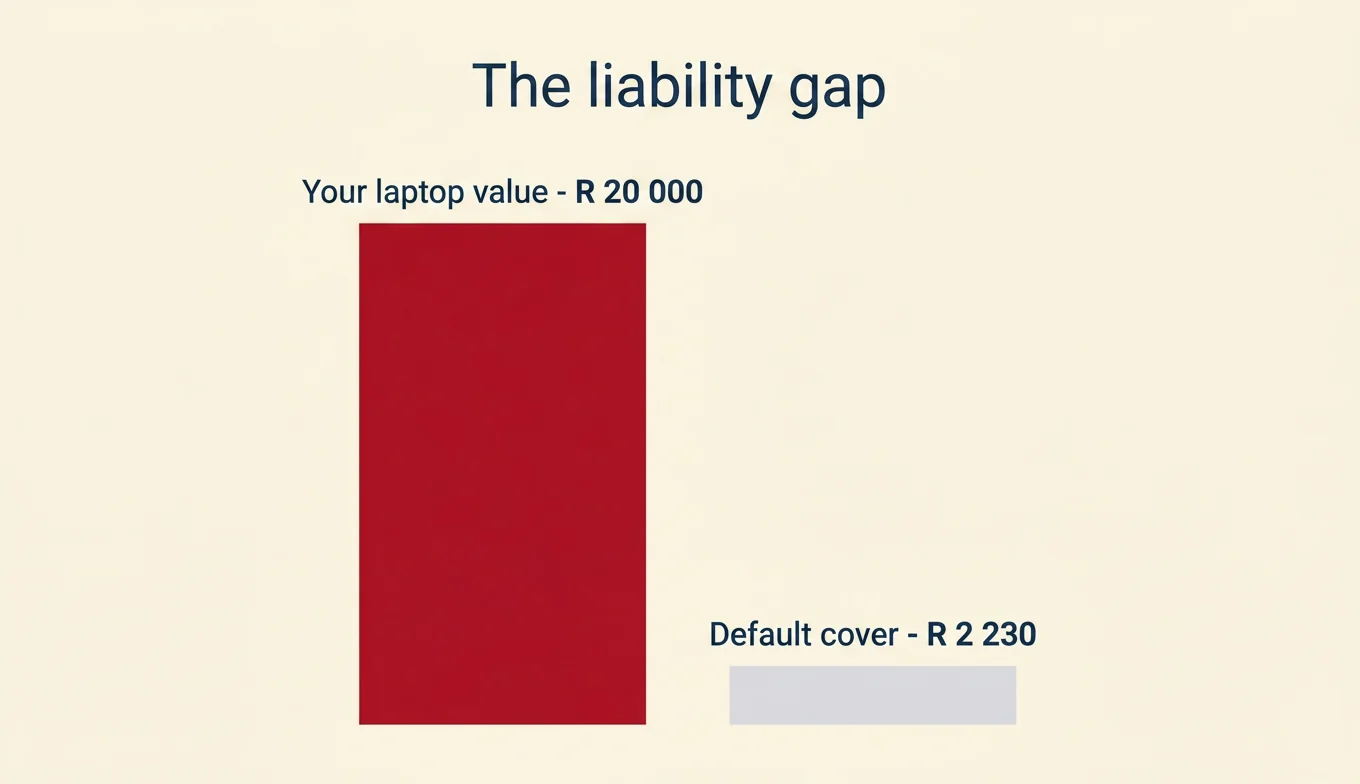
Default cover
Without a declared value, our liability is capped at the treaty default for the relevant transport mode. These limits apply regardless of the actual value of the goods. They are intentionally low — they exist to provide a basic floor of compensation, not full replacement cover.
| Transport mode | Convention | Default cap | Approximate value |
|---|---|---|---|
| International air (most ICD & ICP) | Montreal 1999 | 22 SDR per kilogram | ≈ R 560/kg (at May 2026 SDR rate) |
| Cross-border road (SADC services) | CMR 1956 | 8.33 SDR per kilogram | ≈ R 212/kg (at May 2026 SDR rate) |
| Domestic SA | Local carrier T&Cs | R 1 000 per shipment (default) or contracted higher | Document-and-liability fee applies |
Worked example — air shipment
Default cap = 4 kg × 22 SDR/kg = 88 SDR ≈ R 2 230.
If the parcel is lost, that is the maximum we can pay out — well below the laptop's value. For high-value goods, declared-value cover or third-party cargo insurance is essential.
Declared-value cover
For an additional fee at booking you can declare a higher value, raising our liability cap up to the declared value. Declared value is not the same as insurance — it raises the maximum we can pay out if we are found liable, but it does not change the exclusions below. For true insurance cover that pays out regardless of fault, arrange separate cargo insurance through a broker.
| Service | Max declared value | Premium (typical) |
|---|---|---|
| ICD documents | USD 100 (network maximum for document carriage) | Built into rate |
| ICP parcels | USD 50 000 per shipment (most destinations) | Quoted at checkout based on declared amount |
| Cross-border road | Lower of carrier maximum and shipment value | Quoted at checkout |
Items of extraordinary value — capped regardless
Certain categories of goods are inherently difficult for any carrier to value or replace, and are subject to a separate hard cap (typically USD 1 000 per shipment) even if a higher declared value has been paid. For these categories, separate cargo insurance is the only real protection.
Artwork & antiques
Paintings, sculptures, etchings, antique furniture, collectables. Value is subjective and often irreplaceable.
Jewellery & watches
Set or loose precious metals and stones (loose stones are prohibited entirely — see prohibited items).
Precious metals
Bullion, gold/silver coins, ingots.
Film, photographic chromes & slides
Original negatives, master prints. The market value can be a tiny fraction of the artistic or historic value.
Glassware & plasma screens
Glass mirrors, ceramics, glass-faced electronics. High breakage risk; default cap applies even with declared value.
Furs & leather goods
High value and difficult to insure traditionally.
Negotiable instruments
Bonds, share certificates, cash letters payable to bearer (most of these are prohibited entirely).
Sports cards, memorabilia, customised musical instruments
Collector value not reliably ascertainable.
When we cannot pay out at all
Even within the default liability framework, certain causes of loss or damage are excluded entirely. The list below is paraphrased from the standard international air-carriage exclusions and reflects what every carrier in our network applies.
Sender or recipient error
Inherent vice or defect of the goods
Improper packing, marking or addressing
Force majeure
Sealed packages where the seal is unbroken at delivery
Customs or regulatory delays
Magnetic tape data, photographic images, soundtracks
Pre-named fragile categories
Prohibited items
Perishables, temperature-sensitive goods, plants, tobacco, alcohol, electronics, batteries, cosmetics, candles
Computers and electronics not in original packaging
Claim time limits
The treaty framework sets strict deadlines for claims. Miss them and the right to claim is extinguished — irrespective of the merits. Lodge any claim in writing as soon as you become aware of the loss, damage or delay.
Damage to cargo (air)
- Window
- 14 days from delivery
- Source
- Montreal Convention Art. 31
- How
- Written notice to Interdoc with photos & description
Delay (air)
- Window
- 21 days from date placed at consignee's disposal
- Source
- Montreal Convention Art. 31
- How
- Written notice to Interdoc
Loss / non-delivery
- Window
- 9 months from tender to carrier (network practice)
- Source
- Carrier-network terms
- How
- Written notice with waybill number
Damage / delay (road)
- Visible damage
- At time of delivery (immediate)
- Hidden damage
- 7 days from delivery
- Delay
- 21 days from delivery
- Source
- CMR Convention Art. 30
Legal action
- Air
- 2 years from delivery or scheduled delivery (Montreal Art. 35)
- Road
- 1 year from delivery (CMR Art. 32); 3 years for wilful misconduct
Money-back guarantee
- Window
- 15 days from invoice date or shipment date
- Threshold
- Delivery more than 60 seconds after committed time
- Excludes
- Force majeure, customs delay, B2C, DG, undeliverable
How to lodge a claim with Interdoc
- Waybill / tracking number
- Date of delivery (or attempted delivery)
- Nature of the claim (damage / delay / loss / shortage)
- Detailed description of what happened
- Photographs of damage (multiple angles, original packaging visible)
- Copy of the original commercial invoice or receipt showing value
- Statement of declared value paid (if any)
- Your contact details for follow-up
Frequently asked questions
What is the Montreal Convention liability cap?
What is an SDR?
What if I ship a R 20 000 laptop without declared value?
What is the difference between declared value and insurance?
Are there items I can't fully insure even with declared value?
How long do I have to claim for damage?
How do I lodge a claim?
Sources & attributions
The liability framework, SDR units, claim windows and convention citations on this page derive from international transport treaties and the International Monetary Fund. Treaty text is quoted under public-domain convention — international treaties are not subject to copyright.
Primary upstream sources
- Montreal Convention 1999 — Convention for the Unification of Certain Rules for International Carriage by Air; Articles 22 (liability cap, 22 SDR/kg per 2009 inflation revision), 31 (claim time limits — 14-day damage, 21-day delay), 35 (2-year limitation)
- Warsaw Convention 1929 + Hague Protocol 1955 — legacy air-carriage liability framework, applies where Montreal does not
- CMR Convention 1956 — Convention on the Contract for the International Carriage of Goods by Road; Articles 23 (8.33 SDR/kg cap), 30 (claim windows), 32 (1-year limitation)
- International Monetary Fund (IMF) — Special Drawing Right basket valuation, used by all transport treaties for liability denomination
Industry standards & terminology
- SDR per kilogram — universal liability convention
- 22 SDR/kg air-cargo liability cap (Montreal 2009 inflation adjustment)
- 8.33 SDR/kg road-carriage liability cap (CMR Article 23(3))
- 14-day damage / 21-day delay / 2-year limitation — Montreal Article 31 & 35
- "Declared value for carriage" vs "declared value for customs" — universal distinction
- Items-of-extraordinary-value cap convention (USD 1 000 typical)
All original prose, worked examples, the laptop liability calculation, the "how to lodge a claim" workflow and the SDR-to-ZAR contextualisation are the original work of Interdoc and have been verified against publicly indexed web content as not derived from any specific carrier's documentation.